


Human Rights and Labor Practices


Goals and Performance Highlights
Goals


Performance in 2025



Challenges and Opportunities
The Company manages its workforce based on principles of equality and ethics, in strict compliance with labor standards and applicable laws.
We are committed to fostering a non-discriminatory work environment (Non-discrimination), regardless of race, religion, gender, age, or social status, while placing the highest priority on occupational health and safety (Occupational Health and Safety) to systematically prevent workplace accidents and illnesses in accordance with international standards. In this regard, the Company has also extended its governance scope to suppliers across the supply chain to collectively promote a transparent, safe, and socially responsible business in all dimensions.
Management Approach and Value Creation
The Company has established policies and guidelines to ensure that its business activities do not involve human rights violations throughout the value chain, in accordance with the Universal Declaration of Human Rights (UDHR), which directors, executives, and employees at all levels are required to strictly adhere.

The scope of assessment is also extended to key business partners, including Critical Tier 1 and Critical Non-Tier 1 suppliers, in order to identify and manage potential risks that may affect the health and well-being of employees and service recipients. These efforts are implemented alongside systematic occupational health, safety, and working environment management to prevent potential impacts on employees, service recipients, and stakeholders throughout the business value chain. The assessment covers personnel at all levels, from executives to operational staff, including vulnerable groups such as women and persons with disabilities. The Company also implements appropriate mitigation measures and extends the HRDD process to key suppliers in the Critical Tier 1 and Critical Non-Tier 1 groups to identify and manage potential human rights risks. This process helps ensure that the Company’s business operations comply with ethical principles and promote the wellbeing of all stakeholders. One hundred percent of suppliers in the Critical Tier 1 group and one hundred percent of suppliers in the Critical Non-Tier 1 group have undergone Human Rights Due Diligence (HRDD).
The Company implements an internal Human Rights Due Diligence (HRDD) process that covers personnel at all levels as follows:

1. Executive Level: Governance and Policy Foundation

2. Employee Level: Operational Assessment and Active Participation

3. Monitoring and Mitigation Process
Human Rights Due Diligence (HRDD)
The Company places importance on respecting human rights throughout its value chain by conducting Human Rights Due Diligence (HRDD) to assess actual impacts and identify potential risks that may arise in the future. The Human Resources Department serves as the central coordinating unit, working in collaboration with a multidisciplinary assessment team, including occupational safety officers, the Business Development Department, and the Engineering Department, to evaluate risks across all stakeholder groups.
| No. | Stakeholder Groups / Related Business Activities | Primary Assessor / Reviewer | Assessment Period | ||
|---|---|---|---|---|---|
| Before the Activity | During the Activity | Annually | |||
| 1 | Migrant Workers | Human Resources Department / Occupational Safety Officer | |||
| 2 | Contract Labor | Contract Labor / Occupational Safety Officer | |||
| 3 | Business Partners | Business Development Department | |||
| 4 | Full-time Employees | Employees / Occupational Safety Officer | |||
| 5 | Part-time Employees | Employees/Professional Safety Officers* | |||
| 6 | Employees of Subcontractor Companies Working in the Hospital (Outsource) | Outsource / Human Resources Department / Occupational Safety Officer | |||
| 7 | Customers | Service Recipients | |||
Internal Human Rights Due Diligence Process
| No. | HRDD Process | Approach |
|---|---|---|
| 1 | Assess actual and potential human rights impacts | |
| 2 | Integrate findings and take action to prevent or mitigate impacts | |
| 3 | Track the effectiveness of the Company’s responses to impacts | |
| 4 | Communicate procedures and outcomes of impact management to executives, employees, and relevant stakeholders | |
| 5 | Establish remediation or compensation processes for human rights impacts caused by the Company |
HRDD Process in the Supply Chain
The Company has established a human rights due diligence process within its supply chain, focusing on Critical Tier 1 and Critical Non-Tier 1 suppliers through the following four operational steps:
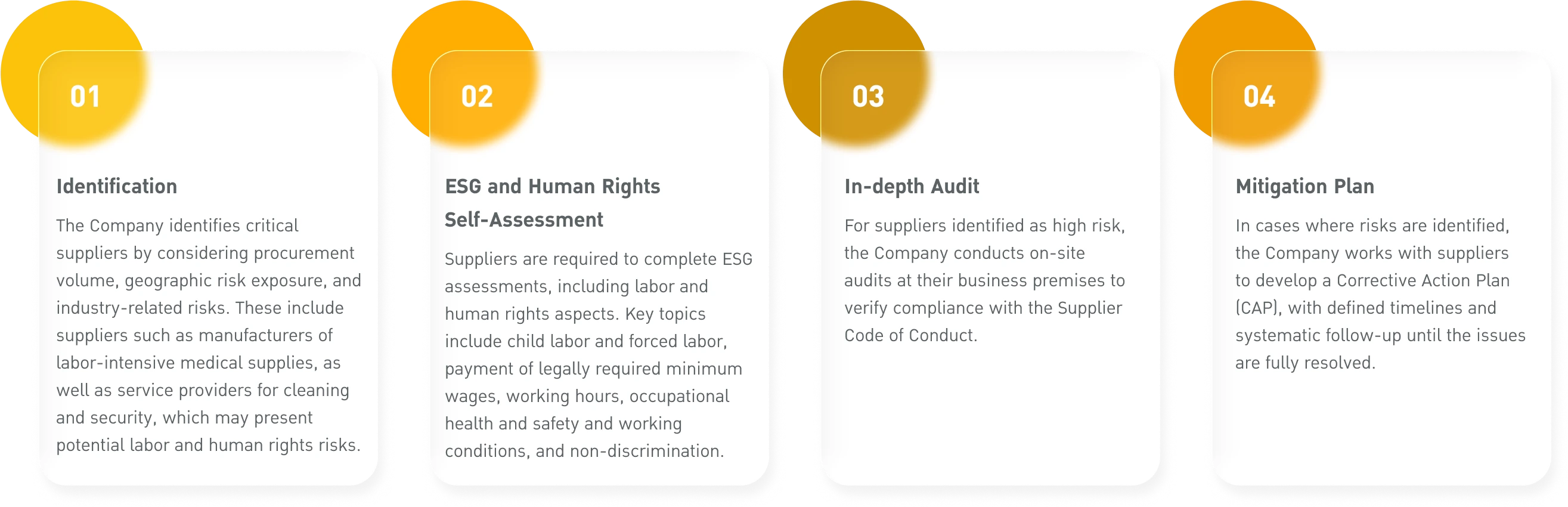


The Company conducted human rights risk assessments covering a total of 60 critical suppliers, comprising:

In 2025, the Company conducted on site audits at the operational facilities of two key suppliers, namely Thai Otsuka Pharmaceutical Co., Ltd. and Master Laundry Co., Ltd. The audit results indicated that both suppliers met the evaluation criteria in all aspects, demonstrating excellent environmental and safety management practices, and no risks or human rights violations were identified. This process was conducted to confirm compliance with the Supplier Code of Conduct.
The above performance results reflect the effectiveness of the Company’s due diligence process, enabling the Company to effectively manage reputational risks while maintaining transparent and responsible healthcare service standards. Based on the comprehensive human rights risk assessment conducted in 2025, no salient human rights risks were identified for the Company or its business partners. Although no severe cases were identified, the Company continues to document observations and areas for improvement, where applicable, and follows up on the completion of corrective action plans within the specified timeframe. The Company remains committed to preventive measures and preparedness through its Remediation Mechanism in the event that unintended human rights impacts occur. The Company has established a remediation and management process to ensure that affected individuals receive fair and attentive support. The operational framework is outlined as follows:

Grievance Channel
Employees, suppliers, and external parties may submit complaints at any time through several channels, including the Contact Center hotline at 1270, email at procurement@praram9.com, and an online complaint form. The Company provides whistleblower protection under a non retaliation policy, and complainants may choose to submit reports anonymously. All complaints will be acknowledged within 5 business days and investigated, with the results communicated within 30 days.

Remediation Process
In the event of an incident that unintentionally affects human rights, the Risk Management Department will conduct a fact finding investigation and present the findings to the Ethics Committee to determine appropriate remediation measures. The proposed measures will then be submitted to the Board of Directors for approval to ensure that assistance is provided in a fair and transparent manner. The remediation process covers the following steps.

Human Resources Responsibility
The Company believes that its personnel are the core of delivering excellence in medical services. Therefore, the Company emphasizes systematic human resource management in accordance with international standards to create a working environment that is safe, equitable, and supportive of continuous learning.
The Company recognizes that human resources are the most critical strategic factor for the Company’s long-term success in combining medical excellence with a human touch in service delivery. The Company therefore places strong importance on systematic Human Capital Management, covering recruitment and selection, capability development and capacity building, fair compensation management, employee well-being, as well as the creation of a safe working environment that respects hum an dignity.
The Board of Directors oversees the strategic direction and policies related to human resources to ensure that workforce management aligns with the business strategy and that human capital risks are integrated into the Company’s Enterprise Risk Management (ERM) framework. This includes consideration of trends in the highly competitive and rapidly evolving healthcare industry, including demographic shifts, shortages of medical professionals, and the expectations of the new generation of employees.
The Company is committed to operating in accordance with human rights principles and fair labor practices under Thai law and international standards, in alignment with the United Nations Guiding Principles on Business and Human Rights (UNGP). The Company integrates Human Rights Due Diligence (HRDD) into its human resource management processes through four steps: risk identification, self-assessment, in-depth review, and mitigatio n planning. These processes aim to prevent and address potential human rights risks both within the Company and throughout the value chain, with the objective of achieving Zero Human Rights Violations.

In 2025, the Company conducted a comprehensive organization-wide human rights risk assessment. The results indicated that
The Company did not have any salient human rights issues.
However, as part of proactive risk management and to further strengthen stakeholder protection, the Company continues to document observations and identify human rights risks that require monitoring, such as risks related to health data privacy. For these monitoring areas, the Company has established systematic preventive and mitigation measures, along with measurable indicators to track performance and link them to the Company’s sustainability performance, ensuring that such issues do not develop into significant risks in the future.
The Company believes that continuous investment in human capital is a fundamental foundation for service quality, organizational competitiveness, and the creation of sustainable value for all stakeholders.
Stakeholders Directly Impacted

Employees

Customers