


PR9 Commitment to the UN Sustainable Development Goals (UN SDGs)

The Company’s Sustainable Development Committee has established both short-term and long-term sustainability management targets at the corporate level.
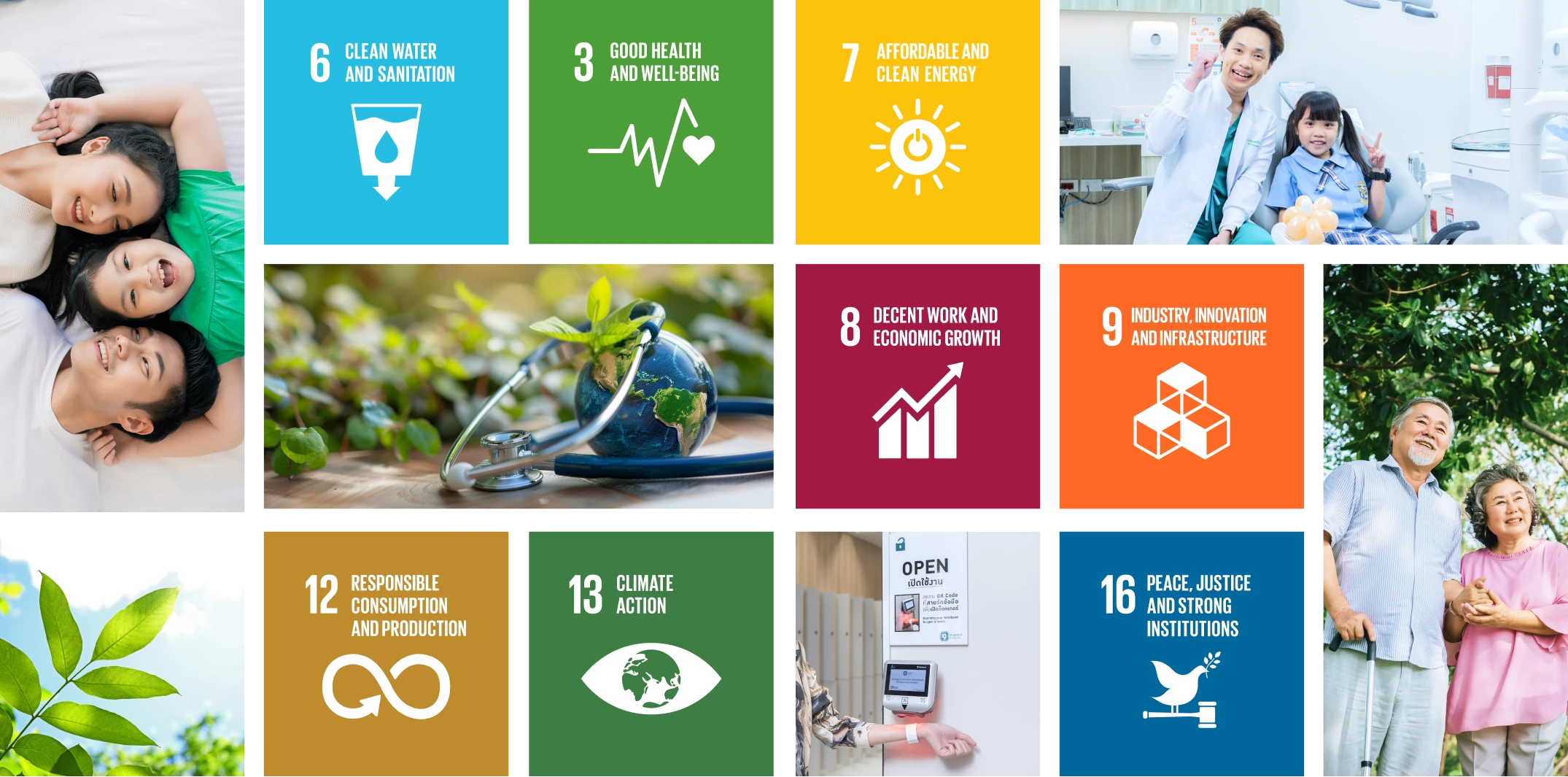
These targets address material sustainability issues across the economic, social, environmental, and human rights dimensions and are integrated with the United Nations Sustainable Development Goals (SDGs). In 2025, the Sustainable Development Committee approved a review and update of the sustainability policy to ensure its relevance and alignment with the Company’s operational direction.

Environmental Dimension


Greenhouse gases are a key contributor to the issue of Climate Change, as they trap heat in the atmosphere and drive shifts in weather patterns. Continuous efforts to control and reduce greenhouse gas emissions under Climate Change Management can help mitigate the severity of climate change and related natural disasters, thereby reducing potential impacts on business operations.
Positive Business Impact / Opportunities
- Strive to become a low-carbon organization and gain recognition for strong ESG performance.
- Reduce greenhouse gas emissions by promoting the use of clean energy, such as solar energy (Solar Cell).
- Continuously improve energy efficiency across operational processes.
- Strengthen competitiveness and reinforce the Company’s environmentally responsible corporate image.
Negative Business Impact / Risks
- Challenges related to initial investment costs for clean energy, such as rooftop solar power system installation (Solar Rooftop).
- Risks arising from fluctuations in energy and environmental policies that may affect investment decisions.
- Risks associated with the impacts of natural disasters and climate uncertainty.
- Potential future cost risks resulting from carbon tax policies.
Management Approach
- Reduce greenhouse gas emissions by promoting the use of clean energy, such as rooftop solar power systems (Solar Rooftop).
- Improve energy efficiency by applying an Energy Management System.
- Drive the Net Zero Carbon target by establishing greenhouse gas reduction measures within the hospital, while systematically monitoring performance and preparing a GHG Inventory.


The procurement and efficient utilization of electricity, water, fuel, and other energy sources reflect effective cost management and demonstrate efforts to reduce reliance on non-renewable or exhaustible energy resources.
Positive Business Impact / Opportunities
- Reduce electricity costs and enhance efficient resource utilization.
- Strengthen business sustainability.
- Support the goal of becoming a Green Hospital.
- Create opportunities to expand energy management practices to other buildings in order to improve efficiency and reduce long-term costs.
Negative Business Impact / Risks
- Challenges in changing personnel behavior regarding energy consumption.
- Limitations of existing equipment with high energy consumption rates.
- Risks associated with the need to invest in upgrading or replacing equipment to improve energy efficiency.
Management Approach
- Apply a Smart Energy Management System to control and optimize energy consumption within hospital buildings.
- Adjust the operating settings of medical tools and equipment to appropriate energy-saving modes.
- Promote the use of renewable energy, such as solar energy (Solar Cell).
- Organize campaigns and encourage participation from employees at all levels in continuous energy conservation and efficiency initiatives.


The efficient procurement and utilization of water reflect effective cost management within business processes and reduce the risk of water resource shortages.
Positive Business Impact / Opportunities
- Manage water consumption efficiently to reduce costs and expenses.
- Control and systematically monitor water usage.
- Promote the reuse of treated water (Water Recycle).
- Strengthen long-term water resource security of the organization.
Negative Business Impact / Risks
- Challenges related to costs and expenditures in developing and maintaining infrastructure for water recycling and reuse systems.
- Control and systematically monitor water usage.
- Risks associated with drought conditions and water scarcity.
- Control and systematically monitor water usage.
Management Approach
- Install and utilize water recycling and reuse systems.
- Provide training to promote efficient water usage.
- Continuously promote water conservation initiatives within the hospital.


Efforts to reduce waste generated from business operations reflect the ability to utilize resources efficiently and minimize negative impacts arising from business processes that may affect communities and society.
Positive Business Impact / Opportunities
- Reduce costs associated with the management and disposal of infectious and general waste.
- Minimize environmental impacts arising from waste management processes.
- Decrease the volume of infectious and general waste through proper segregation in accordance with academic principles.
- Develop systematic and standardized waste segregation and management systems.
- Create added value in line with the Circular Economy concept, such as appropriately reusing medical materials that can be safely reused.
Negative Business Impact / Risks
- Risks arising from non-compliance with applicable laws and regulations.
- Risks associated with improper management of infectious waste, which may cause environmental pollution.
- Cost and expense risks related to the management of infectious waste.
Management Approach
- Apply the Circular Economy concept to waste segregation and resource recovery.
- Segregate and manage waste by category in an efficient and systematic manner.
- Manage infectious waste in accordance with Joint Commission International (JCI) safety standards.

Social Dimension

Positive Business Impact / Opportunities
Negative Business Impact / Risks
Management Approach


Responsibility toward communities and society reflects the Company’s commitment to preventing and mitigating potential impacts arising from its business operations. In addition, continuous engagement in community and social development demonstrates its dedication to sustainably enhancing quality of life, consistent with Contributing to Community and Social Well-Being.
Positive Business Impact / Opportunities
Negative Business Impact / Risks
Management Approach

Customer Responsibility reflects the Company’s commitment to delivering services that enhance customer satisfaction and strengthen trust among customers.
Positive Business Impact / Opportunities
Negative Business Impact / Risks
Management Approach

The Company places strong emphasis on Talent Attraction and Retention by focusing on enhancing employees’ capabilities through continuous development of knowledge and skills across various areas. At the same time, it fosters motivation and organizational engagement to support long-term sustainable growth.
Positive Business Impact / Opportunities
Negative Business Impact / Risks
Management Approach

Governance and Economic Dimension


A robust corporate governance structure and system reflect effective internal control mechanisms that are transparent and equitable, as well as the Board of Directors’ leadership role in setting strategic direction and driving the organization toward sustainable success. This is undertaken with due consideration of maximizing shareholder value alongside responsibility to all stakeholder groups.
Positive Business Impact / Opportunities
- Enhance revenue opportunities by strengthening corporate credibility and building trust among customers, investors, and business partners.
- Reinforce transparency and confidence among stakeholders.
- Mitigate legal and regulatory compliance risks.
- Prevent and reduce risks related to fraud, corruption, and misconduct.
Negative Business Impact / Risks
- Legal and reputational risks arising from non-compliance with applicable standards.
- Increasing complexity and rapid changes in regulatory requirements.
- Costs and expenses associated with compliance and audit processes.
- Operational delays resulting from regulatory enforcement and compliance procedures.
Management Approach
- Integrate ESG principles and relevant standards, such as Joint Commission International (JCI), into operations, supported by clearly defined policies.
- Promote an organizational culture grounded in ethics, good governance, and sound corporate governance practices.
- Provide ongoing training and awareness programs on anti-fraud and anti-corruption practices.


The Company’s innovation development reflects its commitment to enhancing business competitiveness amid evolving economic, social, and environmental conditions. This approach aims to respond to stakeholders’ expectations while creating value for both the business and society.
Positive Business Impact / Opportunities
- Enhance efficiency and elevate the quality of medical treatment and service delivery.
- Strengthen business competitiveness.
- Expand revenue opportunities through the application of Artificial Intelligence (AI) and Telemedicine services for international customers.
Negative Business Impact / Risks
- Prudently manage costs and expenditures associated with high-level investments in new medical technologies.
- Address risks arising from rapid technological changes through continuous adaptation and development.
Management Approach
- Invest in advanced medical equipment and technologies, incorporating AI applications to enhance the quality of treatment.
- Advance operations toward becoming a Smart Hospital by building upon the Smart Checkup initiative.
- Develop the 9 CARE and 9 CARE Shop platforms to support comprehensive healthcare services.
- Expand collaboration with international medical partners to strengthen treatment capabilities.

Sustainable Supply Chain Management reflects efficiency, transparency, and active engagement with business partners throughout the value chain-from supplier selection and procurement processes to supplier evaluation and ongoing collaboration. This approach also includes encouraging suppliers to align with and adhere to the Company’s sustainable business practices and standards.
Positive Business Impact / Opportunities
- Manage procurement processes effectively to reduce costs and enhance operational efficiency.
- Promote procurement from environmentally friendly manufacturers and suppliers to support sustainable business practices.
Negative Business Impact / Risks
- Risks arising from shortages of medical equipment during crisis situations.
- Supply chain uncertainty due to international factors.
- Risks associated with increased supplier costs resulting from the enhancement of product and service standards.
Management Approach
- Revise procurement policies to promote the selection of manufacturers and suppliers that comply with ESG standards.
- Establish and implement a Supplier Code of Conduct to serve as a framework for transparent and responsible business practices.
- Systematically integrate ESG-based supplier evaluation and selection criteria into the procurement process.
