

Governance and Economic
09 September 2025
Smart Hospital project
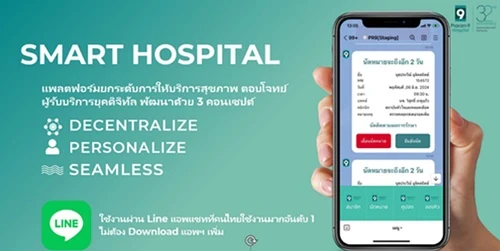
The Smart Hospital project has been developed based on three core concepts:
- Decentralize: Expanding healthcare services to cover both pre-hospital and post-hospital care
- Personalize: Focusing on personalized data storage and communication to deliver services tailored to the needs of patients
- Seamless: Creating a seamless service experience by integrating service data between online platforms and in-hospital services
Development Plan for System and Key Functions
- Digital System and AI Development
- New Hospital Information System (HIS) that integrates all processes
- Implementation of AI Screening
- AI Assistant to provide patient guidance and support healthcare professionals
- Services via LINE Super App The Smart Hospital service has been developed for accessibility through the LINE application, the most widely used platform in Thailand. This integration eliminates the need for users to download additional applications, allowing them to conveniently access services via the Hospital’s LINE Official account.
- Key Functions of Smart Hospital
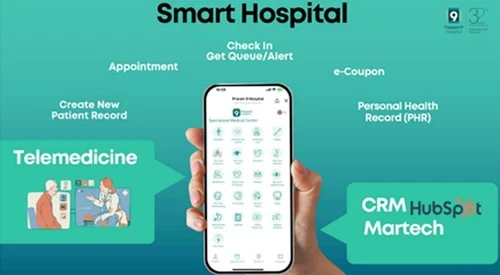
- Create New Patient Record: New patients can register online and receive an automatic queue number when seeking services, reducing waiting time and redundant procedures.
- Appointment Management : Patients can schedule, reschedule, or cancel appointments on their own through the Smart Hospital system, while also checking physician information and consultation schedules.
- Check In & Get Queue/Alert: Mobile Check-in and Real-time Service Route Notifications, including service point locations and queue status updates.
- Coupon and Benefit Management: Check health coupon eligibility and redeem accumulated points for discounts or complimentary gifts.
- Access to Personal Health Record (PHR): View lab results, X-ray reports, medication history, and vaccination records.
Benefits for Patients
- Reduced waiting times and fewer required hospital visits.
- Ability to manage appointments independently.
- Real-time notifications throughout the service process.
- Access to personal health records anytime, anywhere.
Benefits for Healthcare Professionals
- Reducing paperwork and minimizing errors in data entry.
- Enhancing patient care efficiency.
- Decreasing congestion in service areas, such as registration points and examination rooms.
- Providing more time for health consultations with patients.
Positive Impacts
- Enhancing staff efficiency and reducing operational costs.
- Increasing revenue from online services such as Telemedicine and health checkup packages.
- Strengthening the Hospital’s reputation as a leading digital healthcare provider.
- Attracting new patients through referrals and system convenience.
Opportunities
- Expanding Smart Checkup and Telemedicine services to corporate clients.
- Developing AI and Machine Learning to enhance diagnostic accuracy.
- Building an integrated health information system with partner hospitals.
Risks
- Challenges in transitioning to a digital system, which may cause delays in implementation.
- Data security risks (Cybersecurity) requiring stringent management.
- Difficulties in adapting for both medical staff and elderly patients to the new system.
Goals
- Patient Satisfaction.
- Increase in new patients (New HN).
- Enhanced operational efficiency and cost reduction.
- Increased revenue from online services.
Project Implementation Timeline
- 2022: CEO announces the goal of Smart Hospital
- 2023: Digital Transformation and the launch of Lean & Smart Check-Up
- 2024: Development of IT Infrastructure and deployment of AI-Driven Hospital
- 2025: Fully Operational Smart Hospital
The Smart Hospital project integrates technology and innovation to enhance medical services, improving convenience, safety, and efficiency. This initiative not only benefits patients but also optimizes work processes for medical personnel and strengthens the Hospital’s competitive advantage in the digital era.
